Oceanshores Interpretive Center: Now Called the Coastal Interpretive Center
This used to be the website for the Oceanshores Interpretive Center for a number of years.
The current website for the Oceanshores Interpretive Center now called the Coastal Interpretive Center is found at: www.interpretivecenter.org/
The non-profit center continues to educate the public concerning natural and man-made environments on the Washington coast through presentation of the history and ecology of coastal life.
Popular displays include Native American artifacts and basketry, rock identification tables, and several collections of shells and whalebones. There are displays about maritime history, Japanese tsunami debris still washing ashore and information about the history of Ocean Shores. Natural history galleries focus on seabirds, area wildlife and marine life, particularly the Orca whales that live in the waters of the San Juan Islands.
A retail shop is operated on site, offering a wide variety of books and gifts. All proceeds help underwrite the center, which is also member supported.
Located at:
PO Box 1531
1033 Catala Ave. SE
Ocean Shores, Washington 98569
Between the Marina and Community Club.
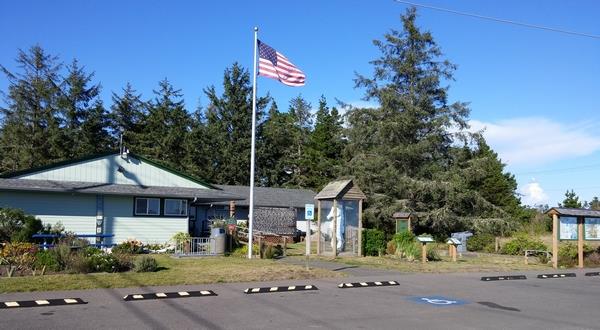
Hours of Operation
March 30 - April 30
Open Thur - Mon
11:00 AM - 4:00 PM
Closed Tue & Wed
May 1 through Labor Day
Open Daily
11:00 AM - 4:00 PM
Sep 5 - Sep 30
Open Thur - Mon
11:00 AM - 4:00 PM
Closed Tue & Wed
Content is from the site's 2002 archived pages and from more recent yelp reviews.
Circa 2002
Foyer
Friendly hosts, like Interpretive Center Association volunteer, Elone Weed, welcome each visitor to the Center.
Walter Weed checks out one of the many titles of books with local interest that are offered in the retail area of the Center. Funds generated pay for exhibits and educational programs.
Local history, such as this display of the famous Chow Chow bridge over the Quinault River on Quinault Indian Reservation land, is fun to learn about through Center displays. This unique model is on loan from the Hoquiam, Polson Museum.
What is that shorebird with the bright red bill? Come to the Center and find out.
You can actually touch the inner ear of a whale at the Ocean Shores Interpretive Center.
Children's Room
Jaws from a Great White shark caught off the North Jetty in Ocean Shores.
Diane Beers is the in-house expert on bones. The kids call her the bone lady.
As Docent she is willing to provide a tour of the center or answer any questions.
In the children’s room are pelts of small mammals and drawers of discovery.
Are antlers bone or dental material? Find out at the center.
Shellfish Room
Here you will find childrens learning activities and discovery drawers, along with shell identification bins.
Recreational shellfish activities, river fishing, surf fishing and shell collecting are topics presented here.
A sand dollar exhibit explains this creature and is one of the favorite exhibits.
Geology Room
The Geology exhibit includes a hands-on rock identification table. Discovery Drawers topics are: Mystery Rocks, Grays Harbor Geodes, Exploration (Margaret Rassmussen collection) and Discover Rocks that contains a great variety of specimens. A co-operative Polson Museum / Interpretive Center display presents a unique collection of Indian artifacts, crystals, igneous, metamorphic, agatized, fossilized and petrified rocks.
This native dried wildflower exhibit from the Hariett Baller collection is a reference tool for both local residents and tourists.
Mammal Room
Small and large mammals such as these are one of the delights of the Point Brown Peninsula
Here you can meet a Black bear face to face. Have you ever seen a mother beaver and her baby? This bobcat, very common in Ocean Shores, is definitely bigger than your house cat
Indian Room
Indian Basketry
The basketry art work of Harriet Baller is displayed in an exhibit of its own with additional ethnology displays of Bear Grass and Sweet Grass.
This modern version of a northern Salish totem pole has a spot in local history as an artifact of the Ocean Shores Inn.
Seafaring Are
The Point BrownPeninsula is located at the northern end of the grave yard of ships. Displayed are three of the most famous historical local ship wrecks.
Commercial Dungeness crab fishing is a heritage industry still functioning off shore. This old survival suit is one of the seafaring exhibits.
The S.S. Catala tied up at the Marina for use as a hotel. This picture was taken from an 8mm home movie that was made in 1964.
Yelp Reviews
2017
Cherdud
Port Townsend
Delightful surprise
When we visited Ocean Shores in March, the interpretive center was closed for the season. But we wanted to look around, so we parked and started looking in windows. A staff person happened to be inside, stocking and straightening materials. When she saw us, she opened the door and invited us in. How generous!
This is a fine place to learn about the history and species in the area. Lots and lots of hands-on opportunities to touch feathers and skins and furs - kids will love it.
The detailed history of the native Americans in the area was interesting.
The staff (more than one) were so welcoming and willing to talk with us that we left promising to come back when they are 'open'.
What a delightful and informative afternoon we had.
madierose16
Spokane Valley, Washington
Reviewed 2 weeks ago via mobile
Wow
The people were really friendly and informative! There's actually quite a bit there, very hands on, great for kids!
Thank madierose16
A TripAdvisor Member
Reviewed 2 weeks ago via mobile
Free Fun for the whole Family
This is a non-profit museum style center. The volunteers are really nice and Love what they do. It was a fun visit and we learned a lot. You will be suprised the things you will see and learn. They have a gift shop and you can also make a donation via credit card or cash that is tax deductible.
Dawn W
Topeka, Kansas
8462
Don't Skip!
I highly recommend the Coastal Interpretive Center! I wish we would have had more time to explore the center. There is a great deal of information to look through. The staff is super friendly and informative. Think southern hospitality on the west coast!!! I didn't want to leave. I enjoyed the conversation, hospitality, and information. There is even a nice playground behind the building. My 5 year old son even had a great time looking through the information.He was very curious about the wildlife and tsunamis. He was thrilled when they gave him a sand dollar and let him pick a seashell.
I very much hope I get the opportunity to return to the Coastal Interpretive Center!!
Kay L
Calgary, Alberta, Canada
Reviewed 4 weeks ago
Good place for education
Not much else to do in Ocean Shores that's healthy when it's rainy and cool. This place used to be supported by local taxes, not anymore. All they get is our visitors' donations. Nice array of displays, including local shellfish varieties, taxidermy, earthquake. We can also pick up most things to check out. I liked being able to feel and compare different pelts.
2014
Angela G
Reviewed September 25, 2014 via mobile
Awesome every time we visit
There is always a docent if you have questions. There is a small gift shop with a decent collection of books. Not a touristy one with lots of knick knack stuff. The exhibits are very informative covering both historical and natural history. A real gem. Supported by volunteers and donations rather than expensive entry fees, so please be generous.
Paul_in_Seattle
Seattle, Washington, Usa
Reviewed September 23, 2014
Coastal Interpretive Center is a Hidden Gem on Washington Coast
We stumbled on the delightful Coastal Interpretive Center on our way to Damon Point. It doesn't look very big or impressive on the outside, but it is surprising how much is there. Piles of whale bones and baleen, pelts of beavers, an alarmingly large stuffed sea otter, seashells, birds, and much more. Pelts, shells, bones, and much more can be handled. Lots of drawers to pull out and discover more Interesting artifacts. Flotsam picked up on nearby beaches include giant bamboo from Japan and a Japanese Sprite bottle, along with a large buoy and tsunami debris.
Geological displays tell the story of plate tectonics assembling Washington, tsunamis, and the local growth and erosion of Damon Point, formed around shipwreck. Lots of relics from the ship are there, and other historical artifacts telling the story of Ocean Shores from the Quinault Indians to the fur trade to Euro-American settlement and modern commerce. Find information on toxic algal blooms, shorebird migrations, by-the-wind sailors, and even bigfoot.
The gift shop has a surprisingly well-stocked collection of books on all kinds of natural and human history. Hallways are narrow, but there are a wheelchair and a walker available. We stayed probably less than an hour because our teens were impatient, but I could easily have stayed longer. The docent (I didn't get his name) made a huge impression on my kids because he was wearing the exact same Batman t shirt they were wearing (Batman Begins) and when they pointed this out to him, he was able to make several references to actual local bat facts that were fascinating. They asked him where he got his shirt and it also turned out to be the same online store where we purchased ours. His lighthearted demeanor made our day and his knowledge of natural surrounding in this area was both fascinating and informative. Plus, he's a fellow Batman fan! And he was so patient and informative, explaining to us amazing things about the maritime environment that we never heard of before. Admission is free, but we happily gave more than the suggested $5/person donation. Outside look for interesting flotsam, art, trails,driftwood.
While you are in the area, take a walk out to nearby Damon Point to watch pelicans, cormorants, gulls, shorebirds, snowy owls, and kite surfers, depending on the season.
janboBC
BC
Reviewed September 20, 2014
A great thing to do when you are in Ocean Shores.
Visited today on our drive down to Quinault. Very informative about the area and its history. The staff encourage interaction with the exhibits and are extremly passionate with what they do.There is no admission fee but donations are happily accepted.
axs666
Canberra, Australia
Reviewed September 7, 2014
Folksy and fun
Pro tip - donation $5 suggested, worth every penny. A great little place to visit and get your learn on. It's essentially a little micro-museum with a variety of exhibits centered around Grays Harbor. There's a shipwreck section, fowl and fauna taxidermy, shells, marine animals, etc. They encourage visitors to touch stuff. Extremely kid friendly. And the staff was super folksy and engaging. Highly recommend.
ready_2_retire_59
Seattle, Wa
Reviewed September 2, 2014
Good place to visit on a foggy morning
Sections on almost every aspect of life in a seashore environment, including birds, animals, tides, history of the area, etc. I especially liked the exhibit on ocean debris and the items that have washed ashore from the tsunami.
Jane H
Spokane, Washington
Reviewed August 24, 2014
Informative
Loved all the hands on activities (especially if you have kids) and all the information they gave. Got a question, just ask these folks are well educated and informed. This place is worth seeing.
Thank Jane H
a v
Reviewed August 21, 2014
good place for older and younger
the people there were so helpfully friendly and knowledge about the area and ocean we give it thumbs up
Thank a v
Skyy419
Seattle, Washington
Reviewed August 19, 2014
So fun for the kids
the kids loved this they learned a ton about so many different things.....almost everything was hands on the staff was amazing and helpful and answered all 6 of the girls questions patiently and explained things to them in a way they could understand they had a fun tiny playground out back to enjoy and the exhibits were really fun for the kids all 6 loved it....the gift shop is the perfect place for ocean themed souvenirs much better then the generic gift shops everywhere and each them was able to find something affordable and fun to take home....best of all they all were much more interested and informed about so many things.....I would recommend this for any age but especially for families with school aged kiddos
OSL0cal
Ocean Shores, Washington
Reviewed August 13, 2014
Do go, a neat free museum
Highly recommend seeing this place while you are in town. Lots of interesting displays including rocks, shipwrecks, and wildlife of the Ocean Shores area. Nice people who often are knowledgable and happy to chat about their area of expertise.
Thank OSL0cal
PeteVZ
Kirkland, Washington
Reviewed August 4, 2014
You must check this out
Highly recommend and it's Free ! Some very interesting ocean facts and artifacts from the Japan Tsunami. Hard to believe some much stuff floats onto the beaches here in Washington from all around the Pacific rim!
2011
nokaoi48117
Ocean Shores, Washington
Reviewed October 31, 2011
Worth the visit
Great way to spend the day when the weather is bad. Staff is wonderful and very knowable.
TravellingAficionado
Portland, Oregon
Reviewed September 12, 2011
Wealth of information Very Friendly helpful Staff and Free!
We walked in and were greated by two ladies who were very nice and gave us a lot of information not only about the history but things to see in the area. Small place but several little rooms filled with a lot of interesting things....More
Joyce M
Casa Grande, Arizona
Reviewed September 8, 2011
Informative and very interesting.
We thoroughly enjoyed our time spend at this attraction. It is very well set up to see and has many 'hands on' items for children. Besides all the information about the ocean, animals, etc. there was some very interesting items about the history of Ocean...More
Kim N
Puyallup, Washington
Reviewed August 31, 2011
What an awesome treasure!
We have been to many interpritive centers, zoos etc. Infact our entier family enjoys learning about nature and all the "wonders" in it so we spend a lot of time watching the discovery channel animal planet and the like. We also visit every little place...More
DRCtravel
Tulsa, Oklahoma
Reviewed August 24, 2011
Great staff, lots of stuff for the adults and for the young ones too
The place is crammed full of stuff and the 5 and 7 year olds enjoyed touching all the stuff and the staff were kid friendly! Us adults enjoyed all the information too!

More Background On OceanShoresInterpretiveCenter.com
OceanShoresInterpretiveCenter.com once served as the official online home for a small but deeply meaningful educational institution on the Washington coast: the Ocean Shores Interpretive Center. Over time, both the organization and its digital identity evolved, and the institution is now widely known as the Coastal Interpretive Center. While the original website is no longer active in its original form, it remains a valuable archival snapshot of the center’s early mission, exhibits, and community role.
The center itself is located in Ocean Shores, a coastal destination on the Point Brown Peninsula in Grays Harbor. This region is known for its rugged Pacific shoreline, dynamic ecosystems, and a layered history that includes Indigenous heritage, maritime activity, and modern tourism. The interpretive center was created to help visitors and residents alike better understand these interconnected elements.
Ownership, Governance, and Nonprofit Structure
From its earliest days, the Ocean Shores Interpretive Center has operated as a nonprofit organization, supported primarily by volunteers, donations, and a small retail operation. Unlike large institutional museums backed by government funding or major endowments, this center represents a grassroots model of community-driven education.
The governing body—commonly referred to as the Interpretive Center Association—has historically consisted of local residents, educators, and enthusiasts passionate about coastal ecology and regional history. This volunteer-driven structure has shaped the tone and experience of the center. Visitors frequently note the personal engagement of docents, who are not only knowledgeable but deeply invested in the subject matter.
Financial support has traditionally come from:
- Individual donations (often suggested but not required for entry)
- Membership contributions
- Gift shop purchases
- Occasional grants or community partnerships
This funding model reinforces the center’s accessibility. Admission has typically been free or donation-based, making it an inclusive educational resource rather than a commercial attraction.
Location and Geographic Context
The interpretive center sits at 1033 Catala Avenue SE, positioned between the Ocean Shores Marina and the local Community Club. Its location is particularly strategic: it lies near both residential neighborhoods and popular visitor routes, making it easily accessible to tourists exploring the peninsula.
Ocean Shores itself is a unique environment. It is bordered by the Pacific Ocean on one side and a network of bays, wetlands, and rivers on the other. Nearby natural landmarks include:
- Damon Point, a dynamic sand spit known for birdwatching and coastal change
- Quinault River, historically significant to Indigenous communities and early settlers
- The broader coastal ecosystems that connect to the San Juan Islands, home to marine species such as orcas
This setting allows the center to function as both a museum and a contextual learning hub. Visitors can learn about the environment inside and then experience it firsthand just minutes away.
Mission and Educational Goals
The central mission of the Ocean Shores Interpretive Center has always been education—specifically, education about the natural and human environments of the Washington coast. This includes:
- Coastal ecology and marine biology
- Regional geology and tectonic history
- Indigenous cultures and traditions
- Maritime history and shipwrecks
- Environmental stewardship and conservation
The center aims to make these topics accessible to a broad audience, including families, school groups, and casual tourists. Its philosophy emphasizes hands-on learning and curiosity-driven exploration, rather than passive observation.
This approach aligns with broader trends in interpretive education, where engagement and interactivity are prioritized over static displays.
Exhibits and Collections
One of the defining characteristics of the center—reflected clearly in the original website—is its wide range of exhibits. Despite its relatively small physical footprint, the center offers a surprisingly dense and varied collection.
Natural History and Marine Life
A major focus is the coastal ecosystem. Exhibits include:
- Seabird identification and migration patterns
- Marine mammals such as whales, sea otters, and seals
- Shell collections and tidepool organisms
- Educational materials on ocean currents and debris
Particular emphasis is placed on the Pacific Northwest’s marine biodiversity. Visitors can learn about species that inhabit nearby waters, including orcas associated with the San Juan Islands.
Geology and Coastal Formation
The geology section explores how the Washington coastline was formed through tectonic activity, sediment deposition, and erosion. Displays often include:
- Rock identification tables
- Collections of geodes, fossils, and petrified materials
- Explanations of plate tectonics and earthquakes
These exhibits help contextualize the constantly changing nature of places like Damon Point, which is shaped by both natural forces and historical events.
Indigenous Culture and History
The center also highlights the cultural heritage of Indigenous peoples in the region, particularly those connected to the Quinault area. Displays may include:
- Traditional basketry
- Ethnobotanical materials such as bear grass and sweet grass
- Interpretations of local traditions and lifeways
This aspect of the center is crucial for providing historical depth and acknowledging the long-standing human presence on the coast.
Maritime History and Shipwrecks
Given the region’s reputation as part of the “graveyard of the Pacific,” maritime history is a key theme. Exhibits often feature:
- Artifacts from shipwrecks
- Models and photographs of historic vessels
- Stories of navigation, fishing, and coastal industry
The nearby coastline has seen numerous shipwrecks due to rough seas and shifting sandbars, making this topic both locally relevant and historically significant.
Hands-On Learning Spaces
One of the center’s most distinctive features is its emphasis on tactile, interactive exhibits. Visitors are encouraged to:
- Handle shells, bones, and pelts
- Open “discovery drawers” containing curated specimens
- Engage with educational games and activities
This hands-on approach is particularly effective for children, turning the center into a hybrid between a museum and a learning laboratory.
The Gift Shop and Revenue Model
The on-site retail shop plays a dual role. It provides visitors with educational souvenirs—such as books, field guides, and locally themed gifts—while also generating revenue to support the center’s operations.
Unlike typical tourist shops, the emphasis is on educational value rather than novelty. Purchases directly contribute to funding exhibits and programs, reinforcing the nonprofit mission.
Visitor Experience and Reviews
Public reviews over the years consistently highlight several themes:
Welcoming and Knowledgeable Staff
Visitors frequently describe the volunteers as friendly, passionate, and eager to share knowledge. This personal interaction often becomes a defining part of the experience.
Surprisingly Rich Content
Many reviewers note that the center appears small from the outside but contains a wealth of information and artifacts inside. The density of exhibits creates a sense of discovery.
Family-Friendly Environment
The hands-on exhibits make the center especially appealing to families with children. Interactive elements help maintain engagement across age groups.
Value and Accessibility
With free or donation-based admission, the center is widely seen as offering exceptional value. Visitors often express willingness to donate after experiencing the exhibits.
A “Hidden Gem”
A recurring phrase in reviews is that the center is a “hidden gem.” It may not be heavily advertised, but those who find it often consider it a highlight of their trip.
Historical Development and Timeline
The Ocean Shores Interpretive Center has roots going back several decades, with the website capturing a snapshot from the early 2000s. During that time, many small institutions were just beginning to establish an online presence, and the site reflected the design and content style of that era.
Over time, the organization rebranded as the Coastal Interpretive Center, updating its facilities and digital presence to better align with contemporary expectations. Despite these changes, the core mission and many of the exhibits have remained consistent.
This continuity is important. It shows that while the center has adapted to new technologies and audiences, it has stayed true to its foundational purpose.
Relationship to the Broader Community
The interpretive center is deeply embedded in the local community. It collaborates with:
- Local museums and historical societies
- Schools and educational programs
- Environmental and conservation groups
It also serves as a gathering point for residents, offering a space where knowledge is shared and local identity is reinforced.
In a town like Ocean Shores—where tourism plays a major economic role—the center provides a counterbalance to purely recreational activities. It adds an educational dimension to the visitor experience.
Cultural and Social Significance
Beyond its role as a museum, the center represents a broader cultural function. It preserves and interprets the stories of a specific place—its land, its people, and its evolving relationship with the natural world.
This includes:
- Documenting Indigenous heritage
- Interpreting environmental changes such as tsunami debris
- Educating the public about sustainability and conservation
In doing so, the center contributes to a sense of place and continuity. It helps both residents and visitors understand not just what Ocean Shores is, but how it came to be.
Press, Media, and Recognition
While the Ocean Shores Interpretive Center may not have widespread national media coverage, it has earned consistent praise in regional tourism guides, travel reviews, and word-of-mouth recommendations.
Its reputation as a “hidden gem” has arguably been one of its strongest assets. Rather than relying on large-scale marketing campaigns, the center has built its audience through authentic visitor experiences and community engagement.
Audience and Visitor Demographics
The center attracts a diverse audience, including:
- Families with children
- School groups and educators
- Nature enthusiasts and birdwatchers
- Tourists exploring the Washington coast
- Local residents seeking community engagement
Its accessibility and breadth of content make it appealing to both casual visitors and those with more specialized interests.
Legacy of the Original Website
OceanShoresInterpretiveCenter.com stands as a digital artifact of an earlier internet era. It reflects:
- Early 2000s web design and content structure
- A focus on informational clarity over visual sophistication
- The growing importance of online presence for even small organizations
Although the site itself is no longer active in its original form, its archived content provides valuable insight into how the center presented itself and its mission during that period.
OceanShoresInterpretiveCenter.com may no longer function as a primary website, but it represents the foundation of an enduring institution. The Ocean Shores Interpretive Center—now known as the Coastal Interpretive Center—continues to serve as a vital educational and cultural resource on the Washington coast.
Through its nonprofit structure, hands-on exhibits, and community-driven approach, the center has maintained a unique position in the region. It offers visitors more than just information; it provides context, connection, and a deeper appreciation for the natural and human history of the Pacific Northwest.
In an age where digital experiences often dominate, the center’s emphasis on physical interaction and personal engagement remains refreshingly relevant. It stands as a reminder that meaningful learning often happens not just through screens, but through direct encounters with the world around us.